

Cannabinoids List: Types, Effects, and Wellness Uses
Cannabinoids are chemical compounds found in the Cannabis plant, produced by the human body, or created synthetically in a lab. At least 113 distinct cannabinoid compounds have been isolated from Cannabis alone. That number matters because most wellness conversations stop at THC and CBD, leaving out dozens of compounds that interact with your body in meaningful ways. This cannabinoids list covers the full picture: major and minor plant-derived compounds, body-produced endocannabinoids, and synthetic variants, each with distinct chemical forms, receptor actions, and health applications.
1. The complete cannabinoids list at a glance
Cannabinoids fall into three origin categories: phytocannabinoids (from the Cannabis plant), endocannabinoids (produced by the human body), and synthetic cannabinoids (made in a lab). Each category behaves differently in the body. Phytocannabinoids are further split into major and minor compounds, and each compound exists in two chemical forms: an acidic precursor and a neutral, active form.
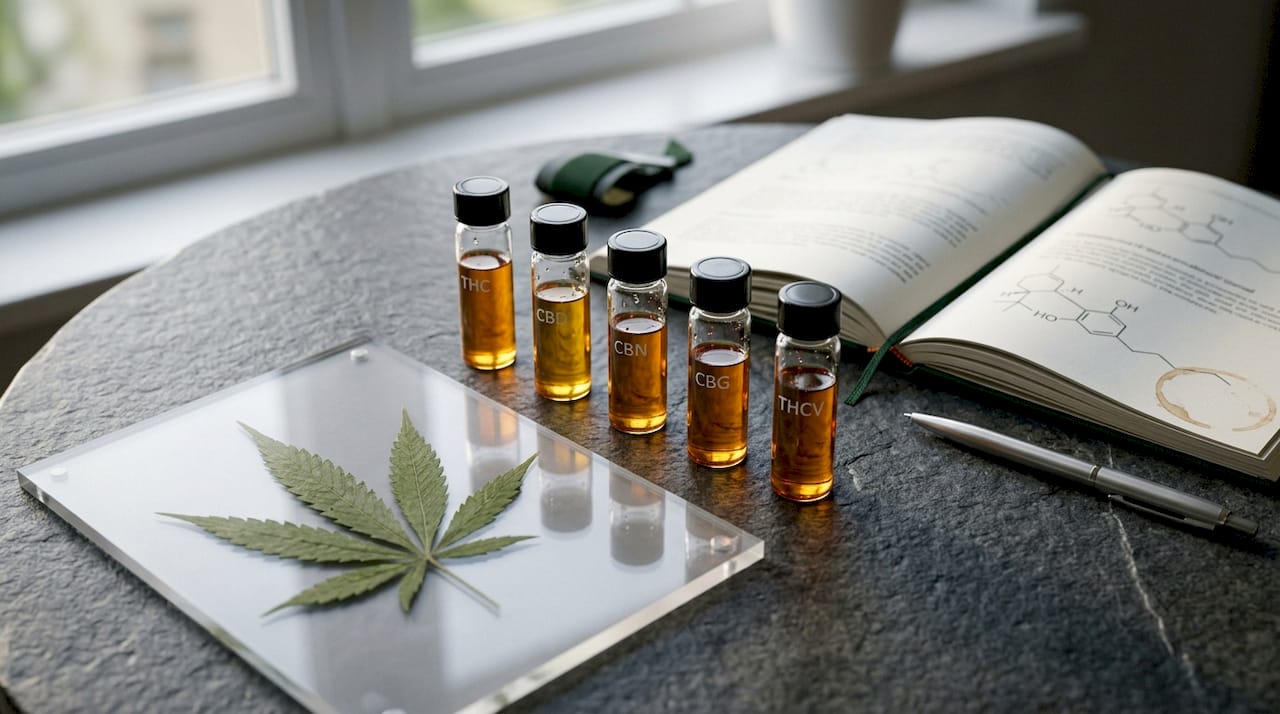
Major phytocannabinoids with the most pharmacological research include THC, CBD, CBN, CBG, CBC, and THCV. Endocannabinoids include anandamide (AEA) and 2-arachidonoylglycerol (2-AG). Understanding where each compound sits on this map is the first step toward making sense of any product label or wellness claim.
2. THC: the primary psychoactive compound
THC, short for delta-9-tetrahydrocannabinol, is the cannabinoid most people know first. THC activates CB1 receptors in the brain, producing the intoxicating effect associated with Cannabis. Its acidic precursor, THCA, is non-intoxicating in raw form and only converts to THC through heat, aging, or UV exposure.
THCA is what you find in fresh, unheated Cannabis flower. The moment you apply heat, whether through smoking, vaping, or cooking, THCA decarboxylates into THC. That chemical shift is why raw Cannabis does not get you high. For wellness purposes, some people use raw THCA specifically because it does not carry the psychoactive effect of THC.
Pro Tip: When reading a product label, look for “THCA” versus “THC.” THCA-dominant products convert to THC only when heated, so the delivery method changes the effect entirely.
3. CBD: the non-intoxicating wellness workhorse
CBD, or cannabidiol, is the second most studied cannabinoid and the most popular in wellness products. Unlike THC, CBD does not bind strongly to CB1 receptors and produces no intoxicating effect. CBD modulates THC’s effects and has its own distinct interaction with the endocannabinoid system (ECS).
CBD’s acidic form, CBDA, exists in raw Cannabis before decarboxylation. Research into CBDA is still early, but it shows promise in areas like nausea and inflammation. Products like CBD gummies typically use the neutral, decarboxylated form. CBD is also the cannabinoid most often paired with THC in clinical research on cannabis use disorder, where the combination reduces withdrawal symptoms in studied populations.
4. CBN, CBG, and CBC: the supporting cast
These three cannabinoids appear in smaller concentrations than THC or CBD but carry distinct properties worth knowing.
- CBN (cannabinol) forms when THC oxidizes over time. It binds to CB1 receptors but with much lower potency than THC. CBN is most associated with sedative effects and appears in aged Cannabis. CBN wellness products are increasingly popular for nighttime use.
- CBG (cannabigerol) is often called the “mother cannabinoid” because CBGA is the biochemical starting point for other cannabinoids. CBG itself is non-intoxicating and is studied for its interaction with both CB1 and CB2 receptors. Products like CBG and THC gummies combine these two compounds for a layered effect.
- CBC (cannabichromene) does not bind strongly to CB1 or CB2 receptors. Instead, it interacts with other receptor targets in the body. CBC is non-intoxicating and is studied for potential roles in mood and inflammation.
Small structural differences among these compounds produce meaningfully different receptor affinities and physiological effects. That is why CBN, CBG, and CBC each have their own research profiles rather than simply acting like weaker versions of THC.
5. THCV and THCP: the potency outliers
THCV (tetrahydrocannabivarin) and THCP (tetrahydrocannabiphorol) sit at opposite ends of the potency spectrum. THCV has a shorter side chain than THC, which reduces its CB1 binding affinity. At low doses, THCV may actually block some of THC’s effects. At higher doses, it produces mild psychoactivity. Researchers study THCV for appetite suppression and metabolic effects.
THCP, by contrast, has a longer alkyl side chain than THC. That structural difference gives it significantly stronger CB1 receptor binding. Products like THCP gummies and THCP jellies are positioned for experienced users who want a more potent experience. THCP is a newer cannabinoid in the commercial market, and long-term research is still developing.
6. Minor and acidic cannabinoids: CBDA, CBGA, and CBCA
Only four cannabinoids have confirmed biogenetic origin as acidic precursors in the living Cannabis plant: THCA, CBDA, CBCA, and CBGA. Every other cannabinoid derives from these four through enzymatic conversion or decarboxylation.
CBGA is the most foundational. The plant converts CBGA into THCA, CBDA, and CBCA through specific enzymes. Acidic precursors decarboxylate to their neutral forms via heating, aging, or UV exposure. This is the core chemistry behind why raw Cannabis and heated Cannabis behave so differently in the body.
| Acidic form | Neutral form | Psychoactive? | Primary research area |
|---|---|---|---|
| THCA | THC | Yes (after heat) | Pain, nausea, appetite |
| CBDA | CBD | No | Nausea, inflammation |
| CBGA | CBG | No | Broad ECS interaction |
| CBCA | CBC | No | Mood, inflammation |
Pro Tip: Raw Cannabis juice or unheated THCA products preserve the acidic form. If you want the neutral, active cannabinoid, heat is required. Know which form a product contains before you buy.
7. Synthetic cannabinoids: lab-made and clinically distinct
Synthetic cannabinoids are manufactured compounds designed to interact with cannabinoid receptors. Some, like dronabinol (a synthetic THC), are FDA-approved medications used for nausea in chemotherapy patients and appetite stimulation in HIV/AIDS. These clinical synthetics are structurally similar to natural cannabinoids and are used under medical supervision.
Illicit synthetic cannabinoids, sometimes called “spice” or “K2,” are a separate and dangerous category. They bind to CB1 receptors with far greater potency than THC and carry serious adverse effects. These are not the same as pharmaceutical synthetics or plant-derived cannabinoids. The distinction matters because the term “synthetic cannabinoid” covers both a legitimate medication and a street drug, depending on context.
8. Endocannabinoids: what your body already makes
Endocannabinoids are cannabinoid-like molecules your body produces naturally. AEA and 2-AG are arachidonic acid derivatives made by the body and are the primary signaling molecules of the endocannabinoid system (ECS).
Here is how they work:
- Anandamide (AEA) binds to CB1 receptors and is sometimes called the “bliss molecule.” It plays a role in mood, memory, appetite, and pain regulation. AEA breaks down quickly in the body, which limits its duration of effect.
- 2-AG binds to both CB1 and CB2 receptors and is found in higher concentrations than AEA. It is the primary endocannabinoid involved in immune function and inflammation regulation.
- Other endocannabinoid-like molecules include noladin ether and virodhamine, which interact with cannabinoid receptors but are less studied.
Phytocannabinoids like THC and CBD work partly by mimicking or modulating these endogenous signals. THC mimics AEA at CB1 receptors. CBD slows the breakdown of AEA by inhibiting the enzyme FAAH, which raises natural AEA levels. That mechanism explains why CBD can affect mood and pain without directly binding to CB1 receptors with high affinity.
9. Comparing cannabinoid types: a side-by-side view
Receptor binding differences from small molecular changes explain why cannabinoids have such diverse effects. The table below puts the major types side by side.
| Type | Origin | Psychoactive? | Key receptors | Common use |
|---|---|---|---|---|
| THC | Cannabis plant | Yes | CB1 | Pain, appetite, nausea |
| CBD | Cannabis plant | No | Indirect ECS | Anxiety, inflammation |
| CBN | Oxidized THC | Mildly | CB1 (low) | Sleep support |
| CBG | Cannabis plant | No | CB1, CB2 | Broad wellness |
| THCV | Cannabis plant | Low dose: no | CB1 (partial) | Appetite, metabolism |
| AEA | Human body | No | CB1 | Mood, pain, memory |
| 2-AG | Human body | No | CB1, CB2 | Immune, inflammation |
| Dronabinol | Synthetic | Yes | CB1 | Clinical nausea, appetite |
Pro Tip: Check product labels for the specific cannabinoid form listed. “Full spectrum” means multiple cannabinoids are present. “Isolate” means one compound only. Each delivers a different experience.
Clinical effects and risks depend heavily on type, dose, and formulation. Oversimplified CBD versus THC narratives miss the full picture. The right cannabinoid for you depends on your goal, your tolerance, and the delivery method you choose.
Key takeaways
The most effective approach to understanding cannabinoids is to track their origin, chemical form, and receptor target before evaluating any wellness claim.
| Point | Details |
|---|---|
| Origin determines behavior | Plant, body, and synthetic cannabinoids interact with receptors differently and carry distinct risk profiles. |
| Acidic forms require heat | THCA, CBDA, CBGA, and CBCA convert to active neutral forms only through heating, aging, or UV exposure. |
| THC vs CBD receptor action | THC activates CB1 directly for psychoactive effects; CBD modulates the ECS indirectly with no intoxication. |
| Endocannabinoids are already in you | AEA and 2-AG are your body’s own cannabinoids; phytocannabinoids work partly by mimicking them. |
| Dose and form change everything | The same cannabinoid in different doses or delivery formats can produce meaningfully different effects. |
What I’ve learned from years of reading cannabinoid labels
Honestly, the biggest mistake I see wellness-focused people make is treating the cannabinoids list like a menu where you just pick the one with the best marketing. CBD is not automatically safe at any dose. THCA is not the same as THC until heat is applied. And THCP is not just “stronger THC.” Each compound has its own receptor story.
The acidic versus neutral distinction is the one that trips people up most. You can buy a THCA product, consume it without heat, and feel almost nothing. Heat that same product and the experience changes completely. That is not a product flaw. That is chemistry. Knowing it puts you in control.
I also think the endocannabinoid angle is underappreciated. Your body already runs on AEA and 2-AG. When you use a cannabinoid product, you are interacting with a system that already exists and has its own balance. Flooding that system without understanding it is how people end up with unexpected effects. Start low, know your form, and read the certificate of analysis before you buy anything.
— Ethan
Premium THCA products worth exploring at Tghhouston
If you want to put this cannabinoid knowledge to work, Tghhouston carries a rotating selection of lab-tested products across every major cannabinoid category. Their two Houston locations, EaDo on Polk Street and Spring Branch on Long Point Road, are open 24/7. Free delivery applies to orders over $100.

For a clean, refreshing way to experience THCA in its acidic form, the THCA seltzer singles are a great starting point. Prefer a multi-pack? The THCA seltzer 4-pack keeps your supply fresh. Tghhouston also stocks Wyld gummies for a familiar, consistent cannabinoid experience. Every product comes with lab testing you can verify, so you always know exactly what you’re getting.
FAQ
What are the main types of cannabinoids?
Cannabinoids fall into three types: phytocannabinoids (from Cannabis), endocannabinoids (produced by the human body), and synthetic cannabinoids (lab-made). Phytocannabinoids are further divided into major compounds like THC and CBD and minor compounds like CBN, CBG, and CBC.
What is the difference between THCA and THC?
THCA is the acidic, non-intoxicating precursor to THC found in raw Cannabis. It converts to psychoactive THC only when exposed to heat, aging, or UV light through a process called decarboxylation.
How many cannabinoids exist in the Cannabis plant?
At least 113 distinct cannabinoid compounds have been isolated from Cannabis. Most exist in trace amounts, with THC and CBD present in the highest concentrations in cultivated strains.
Are endocannabinoids the same as cannabinoids from Cannabis?
No. Endocannabinoids like anandamide (AEA) and 2-AG are produced naturally by the human body. They share receptor targets with plant-derived cannabinoids but are chemically distinct, being arachidonic acid derivatives rather than terpenophenolic compounds.
Is CBD psychoactive?
CBD is non-intoxicating. It does not bind strongly to CB1 receptors and does not produce the high associated with THC. CBD interacts with the endocannabinoid system indirectly and modulates THC’s psychoactive effects when both are present.
Recommended
Before You Go…
Here are a few handpicked articles to inspire your next self-care moment.


